
SUN |
MON |
TUE |
WED |
THU |
FRI |
SAT |
|---|---|---|---|---|---|---|
1 | 2 | 3 | 4 | 5 | ||
6 | 7 | 8 | 9 | 10 | 11 | 12 |
13 | 14 | 15 | 16 | 17 | 18 | 19 |
20 | 21 | 22 | 23 | 24 | 25 | 26 |
27 | 28 | 29 | 30 |
SUN |
MON |
TUE |
WED |
THU |
FRI |
SAT |
|---|---|---|---|---|---|---|
1 | 2 | 3 | ||||
4 | 5 | 6 | 7 | 8 | 9 | 10 |
11 | 12 | 13 | 14 | 15 | 16 | 17 |
18 | 19 | 20 | 21 | 22 | 23 | 24 |
25 | 26 | 27 | 28 | 29 | 30 | 31 |
SUN |
MON |
TUE |
WED |
THU |
FRI |
SAT |
|---|---|---|---|---|---|---|
1 | 2 | 3 | 4 | 5 | 6 | 7 |
8 | 9 | 10 | 11 | 12 | 13 | 14 |
15 | 16 | 17 | 18 | 19 | 20 | 21 |
22 | 23 | 24 | 25 | 26 | 27 | 28 |
29 | 30 |
SUN |
MON |
TUE |
WED |
THU |
FRI |
SAT |
|---|---|---|---|---|---|---|
1 | 2 | 3 | 4 | 5 | ||
6 | 7 | 8 | 9 | 10 | 11 | 12 |
13 | 14 | 15 | 16 | 17 | 18 | 19 |
20 | 21 | 22 | 23 | 24 | 25 | 26 |
27 | 28 | 29 | 30 | 31 |
SUN |
MON |
TUE |
WED |
THU |
FRI |
SAT |
|---|---|---|---|---|---|---|
1 | 2 | |||||
3 | 4 | 5 | 6 | 7 | 8 | 9 |
10 | 11 | 12 | 13 | 14 | 15 | 16 |
17 | 18 | 19 | 20 | 21 | 22 | 23 |
24 | 25 | 26 | 27 | 28 | 29 | 30 |
31 |
By Michael Degan
When Christ Stoltzfus opened the PA Auction Center about 15 years ago, he stepped into a form of commerce at least 2,500 years old.
Historical records tell us that auctions have been held as far back as 500 BC. These sources show that auctions took place in ancient Babylon. But in ancient Rome, auctions as we conduct them today began to take shape.
Roman soldiers frequently auctioned off the spoils of war. A licensed auctioneer, called a magister auctionarium, began the sale by driving a spear into the ground at the site of the auction, a precursor of the auctioneer’s gavel. Ancient Rome also gave us the word auction, derived from auctus, Latin for “increasing.”
Prosperous Roman citizens often used auctions to sell family estates and other possessions to satisfy their debts. Romans who confiscated property from their debtors liquidated those assets at auctions.
In Europe after the fall of the Roman Empire, auctions fell out of favor until around the 18th century. At that time, auctions by candle became popular. In this type of auction, the selling continued until the candle’s flame expired. The method prevented buyers from knowing the auction’s scheduled conclusion so they could unfairly submit last-minute bids just before the sale ended.
When Europeans began arriving in North America in the 17th century, they brought auctions to the New World. The Pilgrims and other settlers conducted auctions to sell crops, livestock, imported goods, tools, tobacco, and property. Auctions were a quick and efficient way to sell goods and acquire cash.
Fur was a highly profitable commodity at that time. One historian wrote of the period that “the Bible and the beaver were the mainstays of the Pilgrims, the Good Book saving their souls and the beaver paying their bills.”
Auction houses
Today usually auctions of famous artworks or the possessions of dead celebrities receive great attention because of the vast sums of money they bring in. These sales are often handled by the large well-known auction houses that opened in the late 17th century, when London newspapers were reporting on art auctions conducted in taverns and coffeehouses.
In 1674, the world’s first known auction house, Stockholms Auktionsverk, opened in the Swedish capital. The world’s second-largest auction house, Sotheby’s, was founded in London in 1744 by Samuel Baker after he auctioned "several hundred scarce and valuable" books. Twenty-two years later, James Christie founded the auction house that bears his name and remains the world’s largest. Christie’s benefitted greatly in sales and reputation when London became a center of the international art trade after the French Revolution.
Who’s a colonel?
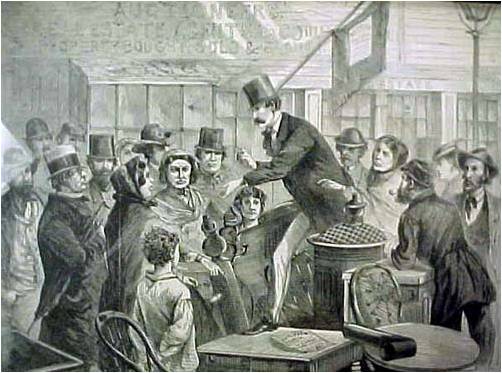
During the American Civil War, victorious Union divisions seized the property and contraband of defeated merchants and land owners. The unit’s commanding officer, very often a colonel, conducted a public sale of the spoils. Eventually, the custom of calling an auctioneer by the unofficial title of colonel developed as they travelled the country conducting auctions, frequently dressed to look like the victorious Union officers who sold confiscated goods and property. Auctioneers are still called colonel in some places (though not at PA Auction Center). Auctioneers have also been called “knights of the hammer” and “brothers.”
Early in the 20th century, auction schools began opening in the United States. Among the first was the Jones’ National School of Auctioneering and Oratory, opened in Davenport, Iowa, by auctioneer Carey M. Jones. The school promised to produce “competent instructors teaching general merchandise, real estate and fine stock auctioneering.” But some auctioneers at the time were skeptical that one could be trained in the art; most believed auctioneering was a natural talent with which one was born.
The auction industry continued to grow until the Great Depression struck in 1929. Auctioneers travelled the country liquidating farms and business that had failed due to natural or financial disasters. But the auction method lost popularity, as it seemed to be profiting off the misery of others. The industry would not rebound until after World War II.
Postwar growth
By the 1950s, the auctioning of goods and, especially, real estate was booming. By closing sales of goods and property faster than was possible in the private market, the modern auction industry was born.
Also in this era, art auctions, once the concern of small groups of dealers and experts, became splashy celebrity-focused events that use expensive and sophisticated marketing campaigns to draw buyers. The development of the “auction chant,” the auctioneer’s frenzied repetition of the last bid while coaxing higher bids, added to the competitive atmosphere of the auction room. Auction houses projected photos of small items up for sale onto large projection screens for physically present buyers who may be situated in the back of a large, crowded hall.
As e-commerce developed during the last decades of the 20th century, auctions gradually added electronic participation via landline and cell phone, fax machine, and the internet. In 1995, Ebay launched and is now the world’s leading online auction, allowing buyers to participate without being present in an auction hall.
By the second decade of the 21st century, both Sotheby’s and Christie’s had introduced online bidding for live auctions. Auction houses continue to expand the infrastructure that allows electronic participation of buyers who may be thousands of miles from the auction site.
Today’s digital technology allows auction firms such as PA Auction Center to provide real-time data and lower transaction costs to a larger number of bidders who can participate in more types of auctions.
Professionalization
The industry’s growth in the 20th century led to a drive toward the professionalization of auctioneers and auction businesses to develop standardized ethics and procedures that instill confidence in the integrity of auctions, prevent fraud, and discourage unfair business practices.
Professional groups such as the National Auctioneers Association provide continuing educational opportunities for auctioneers. NAA auctioneers also agree to operate under ethical standards that protect consumers.
Other organizations accredit auctioneers who have studied a particular niche of the industry. Auctioneers can earn accreditations such as graduate personal property appraiser, accredited auctioneer real estate, and certified estate specialist.
PA Auction Center is an NAA member and also belongs to the Pennsylvania Auctioneers Association. These types of local organizations also help consumers find local auctioneers. They also provide information for anyone interested in becoming an auctioneer.
As anyone who has ever attended a live auction can attest, auctions are fun. Gifted and experienced auctioneers can be entertaining and funny as they egg on potential buyers to pay more, more, more for the item they’re after. The competition can be thrilling to participants, and the “winner” who outbids everyone else for the item they’re after can revel in their “victory.”
Auction theory
But it’s not all dollars and cents. Auctions play a role in the economy, and researchers study them in a branch of applied economics known as auction theory. Auction theory plays a role in the development of new types of auctions. Academics in this field study how some features of auctions can incentivize predictable outcomes. Wikipedia describes it like this: "Sellers use auction theory to raise higher revenues while allowing buyers to procure at a lower cost. The conference of the price between the buyer and seller is an economic equilibrium. Auction theorists design rules for auctions to address issues which can lead to market failure. The design of these rulesets encourages optimal bidding strategies among a variety of informational settings."
In 2020, economists Paul Milgrom and Robert B. Wilson won the Nobel Prize in Economics “for improvements to auction theory and inventions of new auction formats.”
Whether one is buying or selling, whether online or in person, auctions are entertaining events for those who participate, including the experienced and adroit auctioneers whose chants can be as delightful to the ear as an operatic tenor performing a Mozart aria.
For more information, please visit PA Auction Center, Pennsylvania Auctioneers Association, National Auctioneers Association, and the National Auctioneers Foundation.
